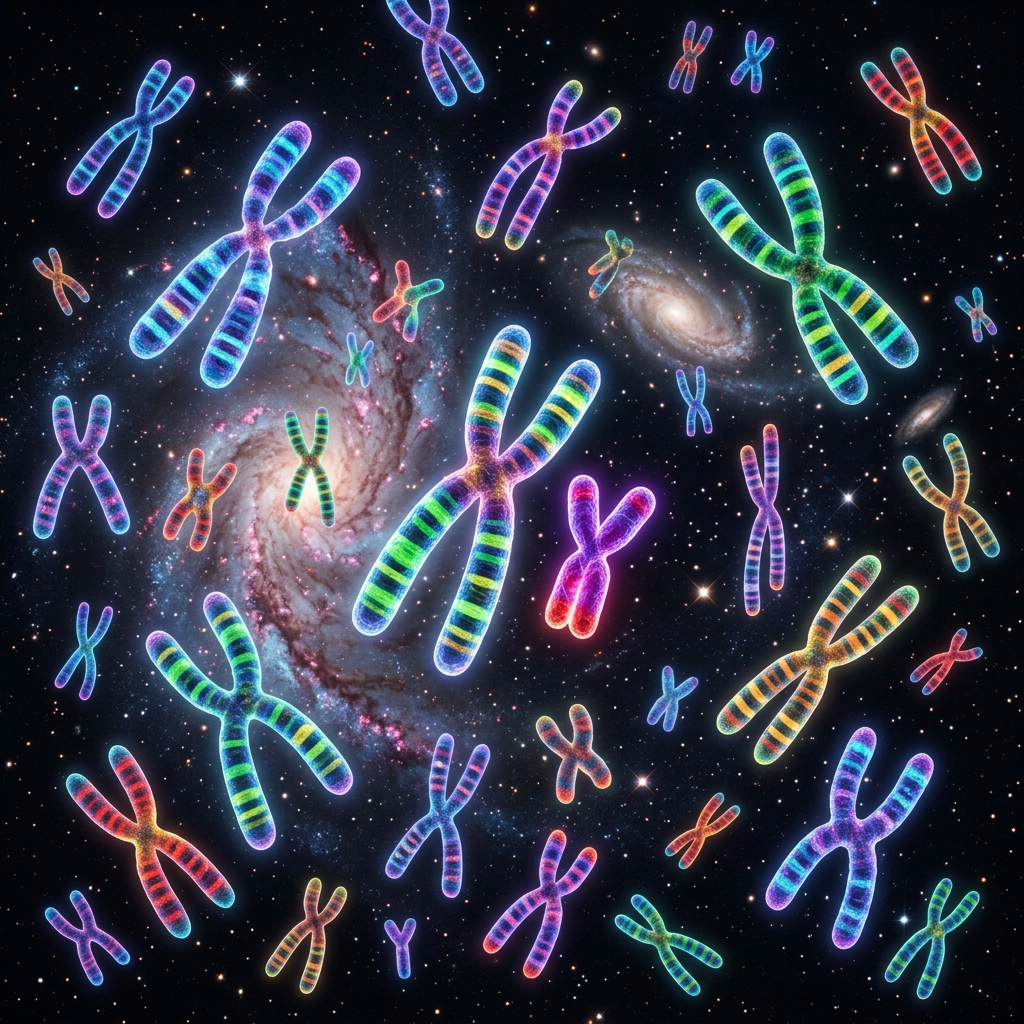
There is something remarkable happening inside every single cell of your body, right now, as you read this. Inside each cell sits a complete set of instructions so precise that no two people on earth share an identical copy. These instructions are stored in structures called chromosomes. Most people have heard the word. Very few have stopped to understand what chromosomes actually do, how they pass from parent to child, or why the long-held belief that a mother decides the sex of her baby is not just wrong, it is scientifically backwards.
What a Chromosome Actually Is
Think of your DNA as a massive instruction manual, one that tells your body how to build organs, fight infection, and decide whether your eyes are brown or green. The problem is that DNA, if stretched out fully from a single cell, would run about six feet long.
Chromosomes are the solution. They are DNA coiled tightly around spool-like proteins called histones, compressing the whole thing into a structure small enough to fit inside a nucleus. Humans have 46 chromosomes arranged in 23 pairs. Twenty-two pairs handle the general business of building and running the body. The 23rd pair is the one that determines biological sex, made up of what are called the X and Y chromosomes. That last pair is where most of the interesting questions about inheritance,syndromes and gender get answered.
The Moment Two Cells Become One
Every human being starts as a single cell formed when a sperm and an egg meet. But before that meeting, both cells go through a process called Meiosis, a special kind of cell division that halves their chromosome count. Normal body cells carry 46 chromosomes. Sperm and egg cells carry only 23 each, so that when they fuse, the resulting embryo gets the full complement of 46.
The journey to that fusion is not easy. At ejaculation, up to a billion sperm are released at once. Most do not make it far. Of that billion, only a few hundred ever reach the egg. Only one gets in. The moment it does, a chemical change seals the surface of the egg, locking everything else out. The 23 chromosomes from the sperm and the 23 from the egg come together, and a new human life,in its earliest, single-cell form, begins. Every instruction for that person’s development, from the structure of their heart to the texture of their hair, is now written in that one cell.
The Myth of the Mother: Who Actually Decides the Baby’s Sex
For generations, and in many places still today, families have placed the responsibility for a baby’s sex entirely on the mother. Women who gave birth to only daughters were sometimes blamed or shamed as though they had failed at something. This belief is not just culturally harmful. It is biologically wrong.
Here is what actually happens. Eggs carry sex chromosomes, but an egg can only ever carry an X. This is because women are genetically XX, and when meiosis divides those chromosomes into gametes, the only option available is X. Sperm on the other hand are different. Men are genetically XY, so meiosis produces two types of sperm in roughly equal numbers: half carry an X chromosome, and half carry a Y. The egg has no say in which type arrives.
If the sperm that fertilises the egg carries an X, the embryo is XX, female. If it carries a Y, the embryo is XY, male. The mother contributes an X either way. She cannot change it. The sex of the baby is decided entirely by which type of sperm reaches the egg first, and that is a matter of the father’s biology and chance.
The Y chromosome is considerably smaller than the X. While the X carries around 900 genes, the Y carries roughly 100, and its main job is triggering male development through a gene called SRY, the sex-determining region Y. Without that gene, the embryo develops along a female pathway by default. Biology, in a sense, starts from female and requires an active signal to become male.
This is not a new or contested finding. It is foundational biology, documented across decades of research. The idea that a mother is responsible for the sex of her child has no biological basis. The sex chromosome that decides the outcome comes from the father, carried by whichever sperm cell wins the race.
Citations
AlphaBiolabs USA. “Which Parent Determines the Sex of a Baby?” AlphaBiolabs USA, 10 Apr. 2026, alphabiolabsusa.com/learning-center/which-parent-determines-the-sex-of-a-baby/.
Cleveland Clinic. “Chromosomes.” Cleveland Clinic, 26 Aug. 2025, my.clevelandclinic.org/health/body/chromosomes.
Live Science. “Chromosomes: Facts about our genetic storerooms.” Live Science, 25 Feb. 2022, livescience.com/27248-chromosomes.html.
National Human Genome Research Institute. “Chromosomes Fact Sheet.” Genome.gov, 9 Mar. 2019, genome.gov/about-genomics/fact-sheets/Chromosomes-Fact-Sheet.
NCBI. “Chromosomal Sex Determination in Mammals.” Developmental Biology, ncbi.nlm.nih.gov/books/NBK9967/.
Pampers. “What Determines the Sex of a Baby.” Pampers, 18 Feb. 2026, pampers.com/en-us/pregnancy/pregnancy-announcement/article/what-determines-the-sex-of-a-baby.
WebMD. “What Are Sex Chromosomes?” WebMD, webmd.com/sex/xx-and-xy-chromosomes.
 BioBitesByKavya